
Distro With an Expiry Date?Gravity Linux is a New Distro for Apple Silicon
Contrary to what you might expect of a newly launched Linux distribution, Gravity Linux has a long-term goal of not existing as a distro. The project is a Fedora Remix for Apple Silicon Macs that ships with KDE Plasma on Wayland as the default desktop.
Everything in it is built through clean-room reverse engineering, ensuring that no Apple source code, disassembly, or leaked technical information makes its way into the code for this project.
Two developers, Cody Ho and Niklas Sheth, are the main driving forces behind this, forking it from Asahi Linux with a shared goal of bringing Linux to Apple Silicon.
They went down this path due to a difference in contribution policy around LLM use.
Gravity Linux’s position is clear from its commit history, where the project’s kernel branch carries commits with Assisted-By tags openly crediting AI coding tools alongside the human author.
What its first release delivers
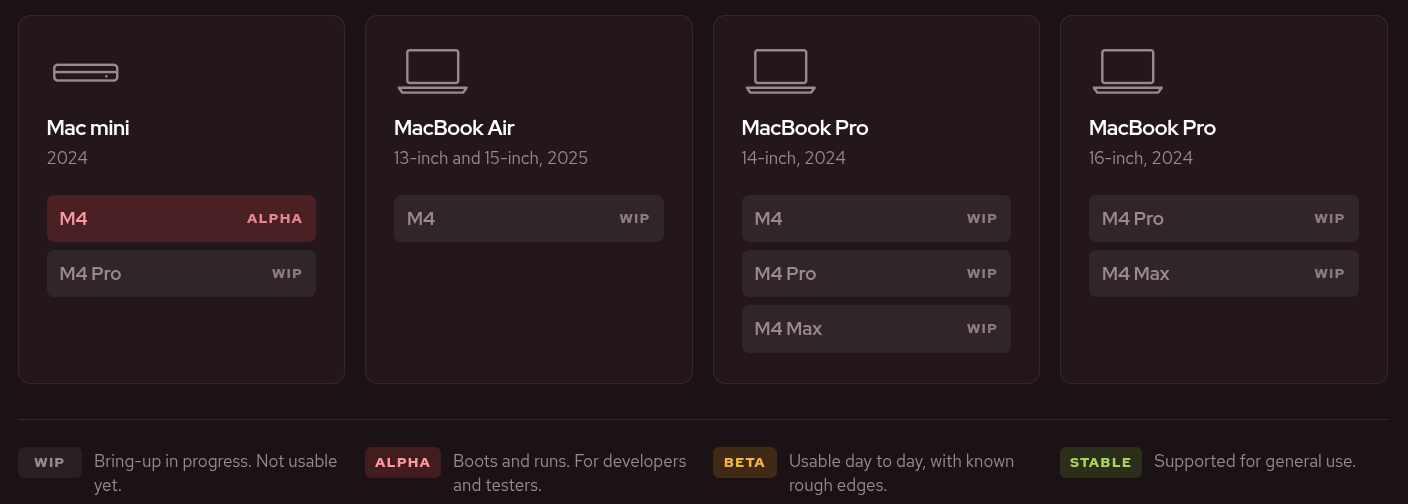
The first alpha runs on the M4 Mac mini, and both the display controller (DCP) and GPU are working, with OpenGL ES 3.0 and OpenGL 3.3 compliance incorporated, meaning hardware-accelerated graphics is available from the first boot.
Keep in mind that this is a developer-focused alpha release with a few shortcomings that make it unfit for daily use. Suspend does not work, Thunderbolt and USB4 support is nonexistent, and USB-C display output is not supported, though output via HDMI works.
Shutdowns and reboots are described as inconsistent, with the power button recommended as the workaround for getting a predictable experience. Speaker volume is also capped for hardware safety.
Users should also understand that a full reinstall will be needed when the beta arrives sometime later, as the Gravity Linux team does not guarantee an upgrade path from the alpha release.
You can get it for your machine by running this:
curl -fsSL https://install.gravitylinux.org | shDistro with an expiry date?
Even though the M4 Mac mini is the first target, it’s not the only one. Current plans cover the MacBook Neo and the remaining M4, M4 Pro, and M4 Max lineup, with some new contributors already making progress on several of those devices.
M5 is a different story. On M5 Pro and M5 Max hardware, macOS 27.0 Beta 5 leaves the devices misconfigured at boot, preventing secondary CPU cores from starting. Apple supposedly knows of this issue, but there’s no news on when a fix will be delivered.
Gravity Linux also plans to keep the entire M5 lineup on the same firmware version before shipping support, so M5 stays on hold until Apple addresses that issue.
The final goal is to upstream all of its driver work to the Linux kernel and relevant userspace projects while documenting its reverse engineering methods publicly at every step.
The GitHub organization already reflects that direction. Beyond distro-layer scripts, the project maintains forks of the Linux kernel, Mesa, and U-Boot. These are the same upstream projects where this work ultimately needs to land.
Once that upstream work lands, any mainstream Linux distribution would run on supported Apple Silicon hardware without needing a separate remix like this. At that point, Gravity Linux the distro stops being necessary, and that is when the team plans to sunset it.
