
Linux Kernel 7.3 Release is Good News For Gamers Short on VRAM
A new kernel release is here about two months after Linux 7.2, and its biggest draw is performance.
Filesystem speedups, scheduler work for gaming, and lower latency for real-time workloads lead the way, with hardware support and a few other smaller changes topping it off.
Of course no new kernel release, even a point release, is complete without a word from Linus Torvalds:
…nothing very special seems to have happened this last week, so as expected the final 7.3 is out, and thus tomorrow the merge window for 7.4 opens. Except I’m on my annual family vacation, so instead of merging anything first thing in the morning, I’ll spend most of the day on a boat and under water. I’ll get back to merging in the afternoon, but I expect my schedule to be a bit unusual for a while.
If you are wondering about “under water”, that’s probably Torvalds referring to scuba diving, one of his rare non-nerdy passions.
Linux 7.3: What’s New?
AMD’s HSMP driver now supports protocol v7, which Zen 6 Family 1Ah Model 80H processors rely on. The CPU manufacturer has been busy laying the groundwork for those chips that are set for a January 2027 launch.
The PMF driver also picks up support for the same family and adds a new ioctl interface that delivers device metrics.
Not everything is Zen 6 groundwork, though. Ryzen AI Halo mini PC owners can now control the lighting of their device when using the kernel through the new amd_halo_led driver.
Before this, toggling the LEDs only used to work via AMD’s Debian-based distro for the device, the Ryzen AI Developer Platform.
If you like tinkering with CPU power behavior, the amd-pstate driver has a change for you.
The opt-in Dynamic EPP (Energy Performance Preference) feature lets the kernel adjust the preference on its own, and it used to be only a system-wide switch. You can now turn it on per CPU core by choosing the “dynamic” preference under the powersave governor.
Older Radeon cards get better recovery from GPU hangs too. Valve’s Timur Kristóf reworked the reset so it only resets the GFX block, the part of the GPU that handles graphics work, and leaves graphics memory alone.
Another Valve engineer, Natalie Vock, has been working on better gaming performance for cards that run short on VRAM, and the first piece of that work is in this Linux release.
Basically, when video memory fills up, the kernel can now move less important data out to system RAM to make room for what a game needs.
With the full set of patches, Indiana Jones and the Great Circle asked for 9GB on an 8GB card and still ran well enough to play. Her full set already ships in SteamOS, and the rest of it is still on its way to Linux.
Then there’s the system memory management tweak, where ZTE engineers found that a lookup used for KSM, the feature that merges identical memory pages, could hold a lock for hundreds of milliseconds and freeze apps under memory pressure.
Their fix brought down the worst case in a stress test from 705ms to under 2ms.
Xiaomi’s Wenchao Hao tackled a similar lock slowdown in zsmalloc, which zRAM and Zswap use to store compressed memory, and saw gains of up to 1.83x on a Raspberry Pi 4B and 1.4x on a 20-core Intel system.
We wrap this up with a few other notable changes:
- RISC-V gains support for eleven newer ISA extensions, and it now uses UEFI runtime services for handling restarts and power-offs.
- Apple’s M3 Pro, Max, and Ultra chips get initial support for booting Linux.
- Intel’s Starfire, a space-grade chip based on Panther Lake, gets its first Linux changes.
- Logitech’s
logitech-hidppdriver enables remapping of buttons on newer, enthusiast-class mice and keyboards through HID++ 2.0. - The
hid-steamdriver now supports the 2026 Steam Controller. - Users of Lenovo ThinkPads with USB-C Restricted Mode Security functionality can now take advantage of it on Linux.
For details on the storage, scheduler, and real-time latency improvements, you can refer to our preview coverage.
Can’t wait to get started?
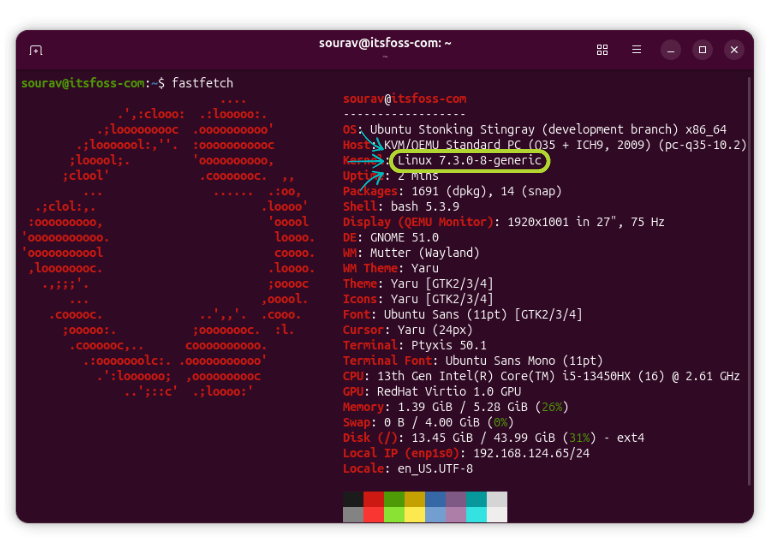
This year’s Ubuntu interim release, Ubuntu 26.10, is the most straightforward way to get on the Linux 7.3 release. If you don’t prefer that distro, then you could always wait for the upgrade to arrive on Fedora Workstation and on Arch Linux and its derivatives.
You could also install the latest mainline Linux kernel on Ubuntu if you don’t mind risking your setup. But remember, there’s a possibility you could lose data, so back it all up before going down that path.
