
Rocky Linux Creator Built a New “Not Linux” Kernel in 11 Days Using AI
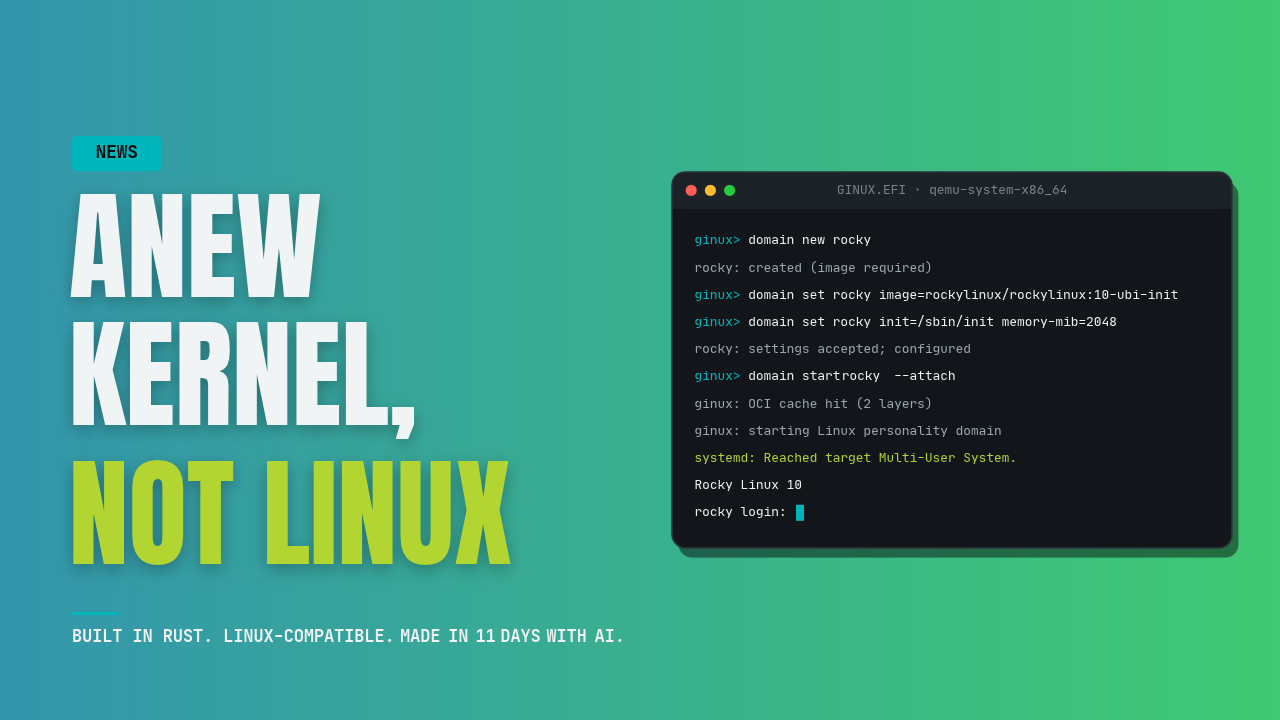
Gregory Kurtzer is no stranger to the Linux world. He created CentOS, and when Red Hat messed it up, he started Rocky Linux as the community replacement. He also co-founded CIQ, the company offering enterprise support around Rocky.
His latest project has nothing to do with rebuilding another Linux distro, though. He has built an entirely new operating system kernel, and he didn’t write most of the code himself. An AI agent did.
Meet Ginux, Linux userspace without Linux underneath
The project is called Ginux. It’s an independent, Rust-first x86-64 kernel. Which simply means it is NOT a fork of the Linux kernel.
It has its own memory management, scheduler, process model, filesystems, networking, and device support, all written from scratch.
The most interesting part is that even though it is not Linux, it is Linux-compatible. Ginux implements the Linux ABI (the binary interface compiled programs use to talk to the kernel), so existing Linux binaries can run on it unmodified.
In the project’s own terms, Linux is a “personality” that Ginux exposes, not the kernel running underneath.
Now, the name Ginux may sound like a mix of GNU and Linux. I hate to disappoint you, it is not the case here.
The G in Ginux stands for GPT. Greg. Kurtzer jokes in the README that, to keep his ego within limits, the G officially stands for GPT. Why GPT? Because it was coded entirely by (Chat) GPT 5.6 Sol.
Here’s how Kurtzer announced it on X (formerly known as Twitter):
In 11 days, I built a new Linux-compatible operating system kernel that boots Rocky Linux 10 with systemd, all using Human-Directed Agentic Engineering (HDAE).
In 11 days, I built a new Linux-compatible operating system kernel that boots Rocky Linux 10 with systemd, all using Human-Directed Agentic Engineering (HDAE).
I call it Ginux. It is an independent, Rust-first x86-64 kernel (not a Linux fork) with its own memory management, boot…
— Gregory M. Kurtzer (@gmkurtzer) October 27, 2026
What Ginux can do today
Ginux builds as a single GINUX.EFI image that boots straight through UEFI, with no Linux host kernel involved.
It runs isolated “domains”, each with its own processes, address space, filesystem, and lifecycle. The project describes these as stronger boundaries than OCI containers or Linux namespaces.
It can also pull and verify OCI container images and use them to assemble a domain’s root filesystem. That’s how it gets Rocky Linux 10 booted all the way to systemd’s multi-user.target. Selected Alpine Linux programs (like the musl and BusyBox) run too.
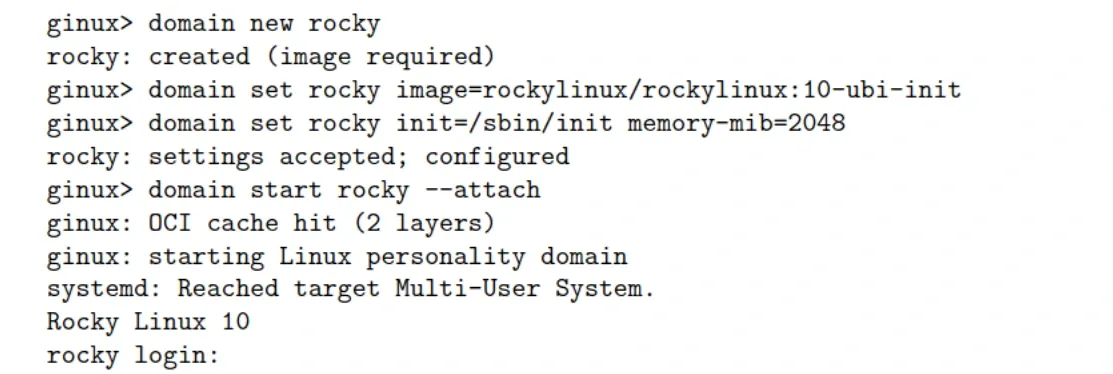
Don’t get too excited, though. Right now, Ginux runs only in a QEMU virtual machine, with no physical hardware profile, no GPU or NVMe support, and no independent security audit.
What is Human-Directed Agentic Engineering?
HDAE is the name Kurtzer gives to the development method, and to be honest, that’s the real story here. He has documented it in a technical report on Zenodo.
The idea is a clear division of labour. The human decides the architecture, the constraints, the milestones, the acceptance criteria, and when to stop. The AI agent runs the implementation loop: write code, boot it, test it, diagnose failures, revise, and repeat against those executable checks.
For Ginux, that meant one persistent OpenAI Codex task running GPT-5.6 Sol for eleven days. It produced approximately 139,000 retained lines of implementation and test code, across more than 1,000 commits. Architecture documents kept the agent aligned, and real userspaces like Rocky Linux caught bugs that synthetic tests missed.
The “human-directed” part matters. This isn’t as simple as typing “write me a kernel, don’t make mistakes” into a chatbot. It’s a person with decades of systems experience steering an agent that does the heavy lifting of coding.
One expert plus AI can go a long way
Kurtzer is careful not to oversell this AI achievement:
The larger lesson is that AI can generate complex systems software, but compatibility, security, hardware support, standards, community, and long-term maintenance remain the real moat.
I think that’s only fair. Linux isn’t going anywhere because a prototype boots systemd in a VM. Decades of hardware enablement, code review, and community are not something an AI agent produces in eleven days.
But let’s take a step back to realize what happened here. A new kernel created from scratch, that runs an enterprise distro. And it took just 11 days with GPT 5.6 (not even 6.1, the latest model).
AI won’t replace expertise. An expert who already knows how kernels work uses AI to squeeze years of grunt work into days.
When people with deep domain knowledge pair it with frontier AI agents, projects that once needed a large team and several years start to look like weekend side projects.
Ginux won’t replace Linux, but it does show how far (and how fast) an skilled person can now go.
