
After Ubuntu, Now Fedora is Jumping Onto the AI Bandwagon With Dedicated AI Developer Desktops
It is getting harder for Linux distributions to stay neutral on AI. Between enterprise-grade solutions like RHEL AI and the steady rise of local inference tools, the pressure to take a position has been building for a while.
Canonical recently made theirs clear, moving Ubuntu toward a local-first AI approach built around open-weight models and open source inference tooling, keeping everything on-device rather than routing it through a cloud subscription.
Now, Fedora has voted on an initiative called Fedora AI Developer Desktop that will spawn AI-flavored Fedora Atomic Desktops.
So Fedora and AI, huh?
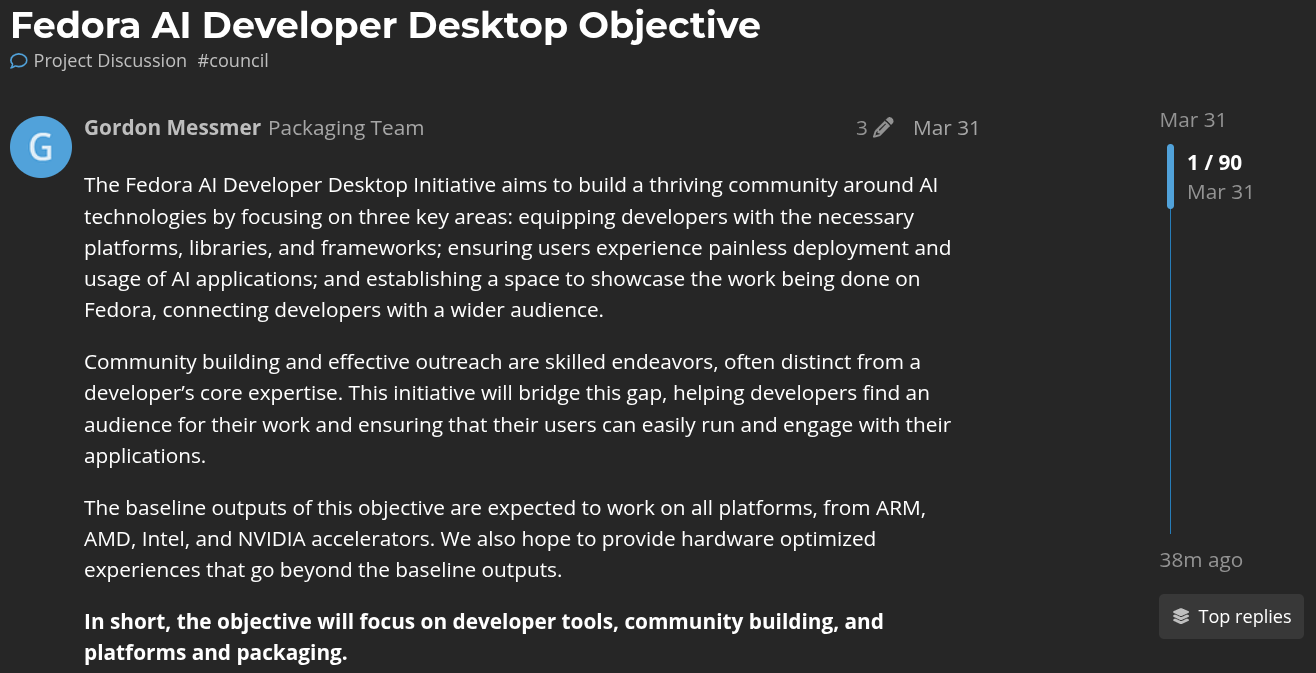
The proposal came from contributor Gordon Messmer from the packaging team at the end of March, and the Fedora Council has since voted on it with a unanimous +6.
Currently, a lazy consensus period is the last thing standing before it is fully official, with Jef Spaleta, the Fedora Project Leader, acting as the Executive Sponsor (to keep things moving).
The goal here is to make AI development on Fedora less painful by introducing better tooling and packaging. It also aims to offer a smoother experience for users running AI applications and a dedicated space for developers to get their work in front of people who might actually use it.
Also worth knowing is that this initiative is not about adding AI tools to Fedora’s existing lineup of Editions or system images. Moreover, none of the resulting images will come pre-configured to connect to remote AI services or monitor how you use your system.
On the technical side, the proposal calls for building an LTS kernel to provide a more stable foundation, alongside bundling user-friendly tools like Goose CLI and Podman Desktop to cover common AI backend workflows.
As for the images this initiative will deliver, there are three planned. The base image, targeting accelerated AI/ML workloads without any proprietary components, will be published as a Fedora Spin.
Two Fedora Remixes follow, one with CUDA runtime support and one with the full CUDA toolkit, the latter of which has some licensing issues that the project will have to tackle.
And before you ask, the developers are planning for a Fedora 45 release timeline for those, which is a few months away in October.
Why though?
Fedora has a habit of being first. Wayland as default, PipeWire, and Flatpak all landed in Fedora before they became the norm across the broader Linux ecosystem. Sitting out the AI wave entirely would be a strange departure from that track record, and probably not a wise one.
Jef, the project leader, has already laid out his rationale, arguing that AI-assisted development is already normalizing upstream. Fedora, he argues, is better off being in that conversation, pushing toward local-first and more ethical tooling, than watching from the sidelines while others set the direction.
However, not everyone is on board. Fernando F. Mancera, a long-time Fedora contributor, withdrew from the project entirely in response, writing “I do not think we can move this forward in a community way. The present situation in Fedora is clearly not for me.”
There are many such disagreements in the thread, ranging from concerns about chasing an AI hype cycle to deeper objections around the NVIDIA/CUDA components and whether the community was brought along properly.
Where Fedora is headed is not that much of a stretch, as the Linux kernel already allows AI-assisted contributions, with an “Assisted-by” tag and clear human accountability as the guardrails. And Ubuntu’s AI roadmap, as you already know, is moving in the same local-first direction.
But whether the project can pull this off cleanly while keeping community expectations and its own philosophy intact remains to be seen.
