
How openEuler Is Reinventing the OS Foundation for the AI Era with SuperPoD and UnifiedBus
The AI doesn’t necessarily run on supercomputers (yet), it runs on clusters of hardware pieced together. This is where SuperPoD comes into picture. A SuperPoD is a tightly coupled scale-up system that connects many compute nodes so software can use resources across them more like one system.
So far, the operating system that ties them in a single machine has largely been proprietary. openEuler wants this to be open source, and its latest release shows the push for that.
Need for cluster OS
Linux provides the base for an excellent operating system. But mostly, the OS is confined to one machine. It schedules the memory, the CPU, and the devices inside a single box, and if you want more, you add another box and wire them together over the network.
This has worked so far, but the AI ecosystem demands more than that. Models now run across racks of machines that have to behave like one giant computer (SuperPOD, again), and the network in between becomes the bottleneck for performance.
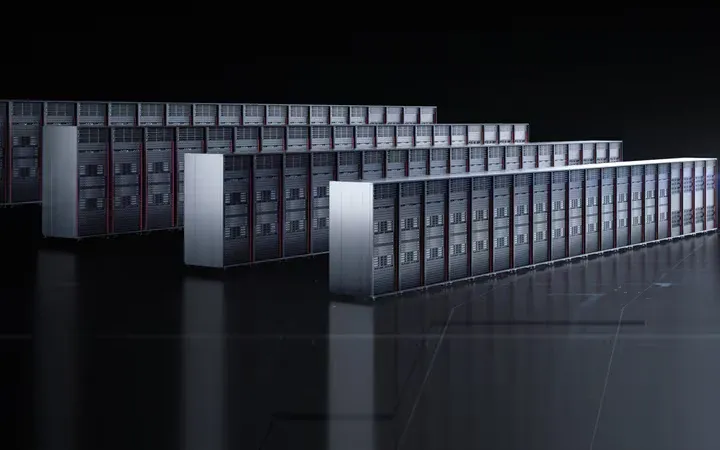
openEuler is an open-source Linux distribution ecosystem, and its newest release ships focuses on running the whole cluster of AI machines as a single, unified system. The code is open and the community is showing interest in adopting it.
A Linux distro built for SuperPOD
openEuler 24.03 LTS SP3, released in December 2025, was the first openEuler version built for SuperPoD. openEuler calls it the world’s first OS to support this architecture.
openEuler supports SuperPoD through UnifiedBus and its OS software stack. UnifiedBus provides the high-speed interconnect, while the UB OS Component and UB Service Core provide OS and cluster-level services on top of it.
A normal Linux system schedules memory and devices inside one node. UB lets applications reach memory and accelerators sitting in other nodes almost as if they were local. So this openEuler release breaks the single-machine boundary and schedules these distributed resources as one single set.
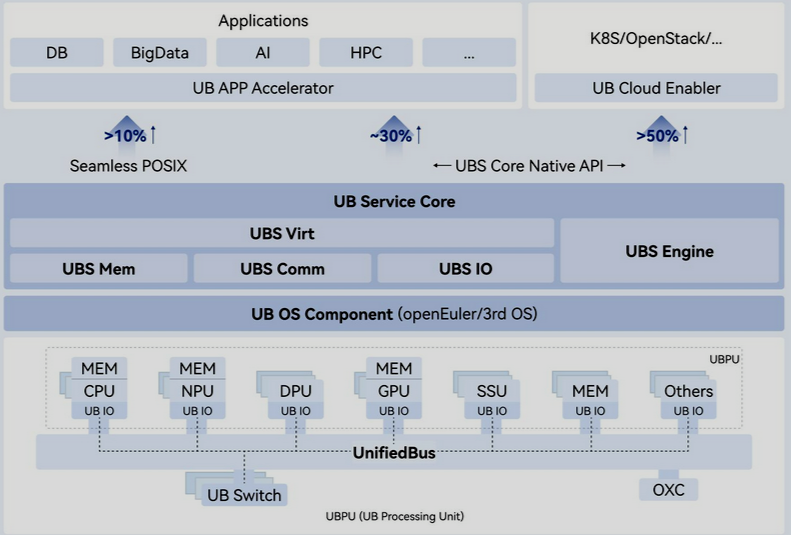
And as you can see, it matters most for the AI hardware. openEuler also did some of its own tests and claims that the peer-to-peer UB design boosts application performance in large-scale AI compute up to 30 to 50 percent.
Where SuperPoD OS comes from
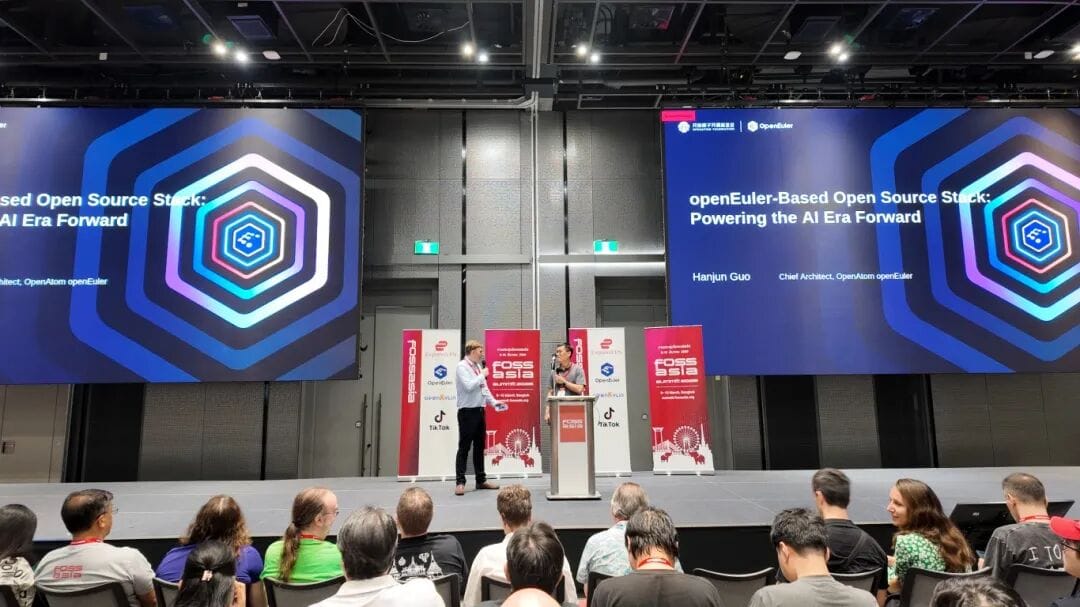
Let me give you some context to why it’s called “world’s first SuperPoD OS”.
openEuler grew out of Huawei’s in-house EulerOS and is now an open-source distribution stewarded by the OpenAtom Foundation. It runs across Arm (including Huawei’s Kunpeng), x86, and RISC-V, and the project has passed 16 million installations by the end of 2025.
SuperPoD and UnifiedBus are Huawei technologies used across multiple computing systems, including Atlas AI systems and the TaiShan 950 SuperPoD for general-purpose computing.
The UB OS Component is open sourced in the openEuler community and forms part of openEuler’s software support for UnifiedBus.
Intelligence BooM, the full-stack AI layer
Another interesting thing that openEuler is pushing for is Intelligence BooM, its open-source, full-stack AI solution. Full-stack here means that instead of running as a tool, it covers the whole software layer an AI workload needs from the OS up.
Basically, it gives you an out-of-the-box setup for training and running large models, so users don’t need to do all the “AI plumbing” from scratch.
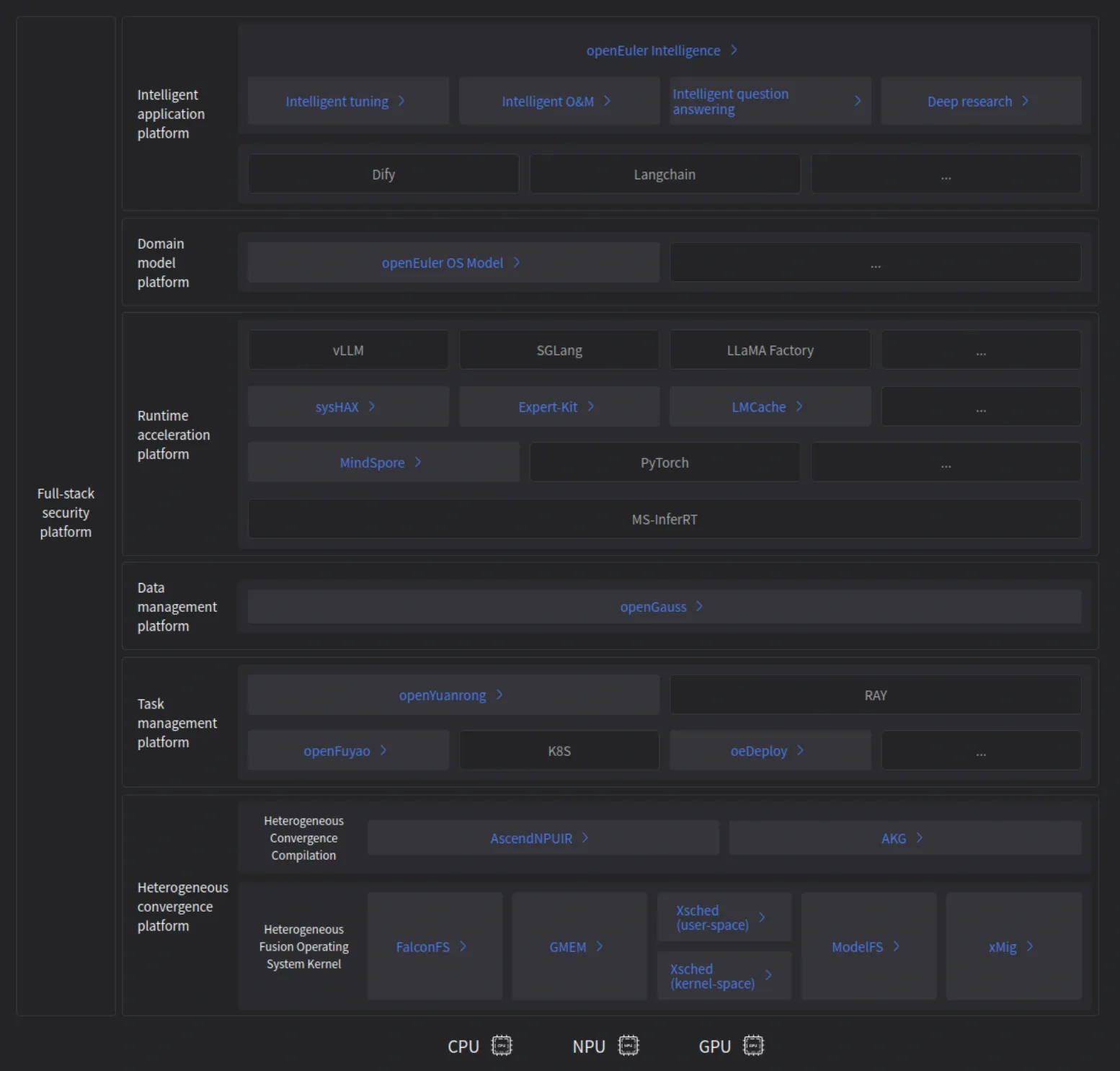
Underneath, openEuler keeps working on the low-level plumbing that makes clusters efficient: combining different chip types into one usable pool (heterogeneous compute fusion), letting CPUs and NPUs work on the same job together (co-computing), and sharing memory across chips and machines (memory pooling).
It also splits a single accelerator so several jobs can share it and packs more than one workload onto the same hardware, both aimed at keeping expensive NPUs and XPUs busy.
For regular Joes like you and me, the most interesting part is the DevStation, openEuler’s desktop build, which ships with an AI assistant that should handle things like installing software or setting up an environment from natural language commands.
We plan to test DevStation and its openEuler Intelligence assistant on an openEuler 24.03 test machine for day-to-day development and general-purpose use.
Moving towards a community ecosystem
It is interesting to see that most of the open source and open-weight AI models are coming from China.
From the enterprise focused UB Service core to user-focused Intelligence Boom, openEuler is keeping things open and that’s a step in the right direction. It is certainly a project to keep an eye on.
If you want to get involved, check out the community page or their GitHub repo for more details.
