
“First We Take Manhattan”: DHH on Omarchy, AI, Asahi and Winning the Linux Desktop
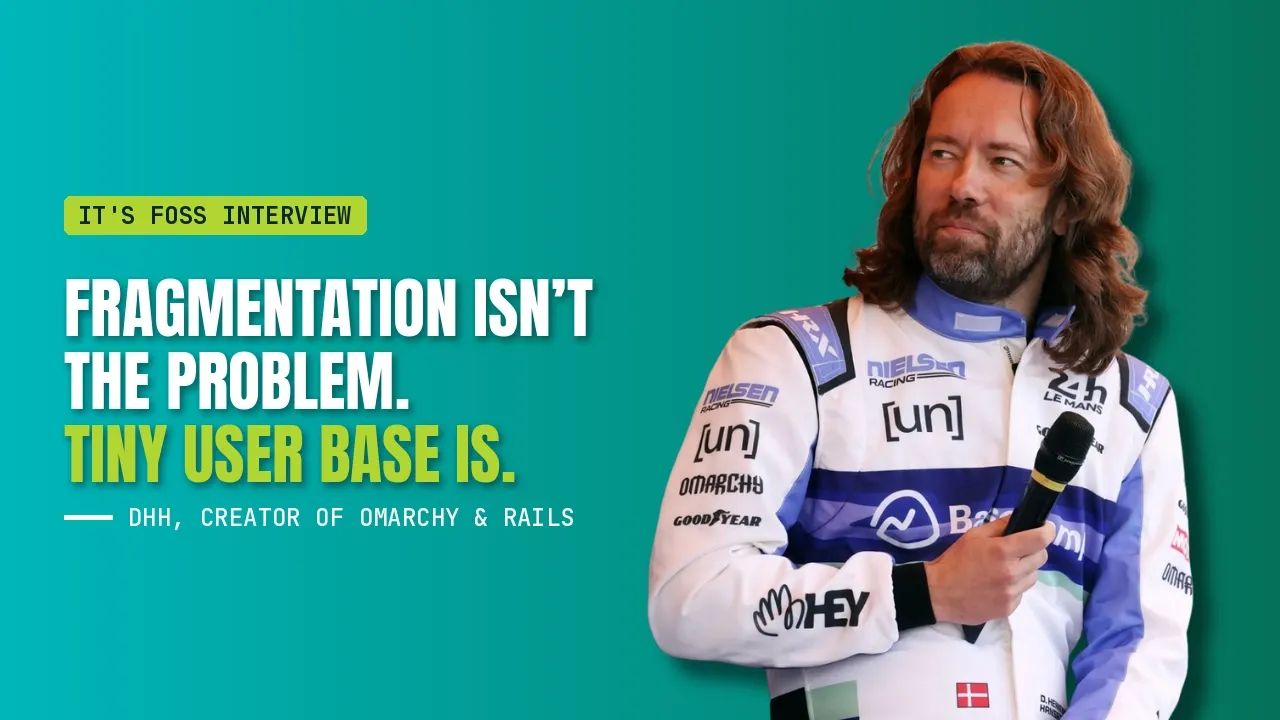
If you have followed desktop Linux this year, you could not have missed Omarchy. And if you have followed Omarchy, you could not have missed DHH.
David Heinemeier Hansson, better known as DHH, created Ruby on Rails and co-owns 37signals, the company behind Basecamp and HEY. In 2025, he released Omarchy, an opinionated Arch Linux setup built around the Hyprland tiling window manager. It looked great and had a keen following. But it was still one more Arch-based setup.
Then AI moved into its core. With Omarchy Quattro, agents became a first-class part of the desktop, and Omarchy took off. It drew in people who had never touched Linux before. Its plugin marketplace crossed 500 plugins in its first week and now has thousands, and the Omacom Foundation has more than 20 million in pledges, including AI tokens from Anthropic, OpenAI and Meta.
That rise has not been quiet. Many long-time Linux users distrust AI-generated code, and the flood of vibe coded plugins has definitely raised real security worries.
Asahi Linux, the project that makes Linux run on Apple Silicon Macs, has a no-AI contributions policy and has just moved from MIT to GPL, citing AI-assisted code laundering. And DHH, never shy of a fight on Twitter, is a polarising figure in his own right.
So I sent him questions over email about all of it: the AI bet, the Asahi licence change, plugin security, the foundation money, his critics and what comes next. Here are his answers, lightly edited for typos.
Omarchy was a nice-looking tiling setup on Arch until AI was added to its core, and then it got extremely popular, even among non-Linux users. Why do you think that happened? What did Omarchy do differently that hundreds of other distros didn’t?
The age of agents is changing everything. We clearly saw its potential with Omarchy Quattro, and it’s no surprise to me that anyone who’s interested in agents is therefore also interested in Omarchy. We’ve simply made the best of a wonderful opportunity that’s been offered to Linux. Meanwhile, lots of other open source projects in this ecosystem have decided to take a very anti-AI stance, and their results are as you would expect.
“Lots of other open source projects in this ecosystem have decided to take a very anti-AI stance, and their results are as you would expect.”
Ubuntu is carefully adding AI to its desktop. We have a couple of examples from China in the form of openKylin and openEuler. Other than those, I don’t see any other major distros doing that. Why has no other major distro gone as far as you?
Ubuntu is built on top of GNOME, which is extremely hostile to the idea of agent development. So it’s not a surprise to me that they’re having a hard time integrating the best of AI into their distribution. The same goes for many other distributions that are deeply entwined with open source projects that are hostile to AI. It’s difficult to fully embrace the age of agents when you’re steeped in such thinking.
Omarchy chose Superwhisper for voice input. Ubuntu has an open source solution for the same. Sometimes it seems that your focus is less on open source and more on Linux.
I don’t have the repulsion to commercial software that many in the old Linux world have. I love commercial options when they give us the best software. I’ve worked on commercial software my entire life. I am happy to integrate the best commercial offerings, whether it’s Superwhisper or Spotify or Dropbox or anything else, into Omarchy. I’m creating a distribution that includes all the software that I personally want to use, and plenty of that software is commercial.
You’ve said that you respect Asahi but disagree with its no-AI policy, and you called for an agent-driven effort to finish M3 to M5 support. This month, Asahi moved from MIT to GPL, citing AI-assisted code laundering. Do you read that as a response to Omarchy?
Asahi changing their license may be a response to Omarchy, but it also doesn’t matter. The Linux kernel is already licensed under the GPL, and we are in full compliance with those terms. We have a bunch of patches to the kernel that are available as open source. If Asahi is licensed in the same way, we will continue as we have all along and build on top of the best open source software. Isn’t that the point of open source? That any project is free to incorporate open software as long as they abide by the license? That certainly is how we approach it within Omarchy. I don’t see how anything changes at all.
Isn’t that the point of open source? That any project is free to incorporate open software as long as they abide by the license?
Many Omarchy supporters seem angry with Asahi. But does the licence change affect Omarchy at all? Omarchy can continue its Mac support work with the MIT-licensed Asahi code it already has.
I don’t think there’s any reason to be angry with Asahi, but it’s fair to be disappointed that our advances can’t be upstreamed such that we could get a single body of work that enables Linux to run well on Macs. But personally, I can’t get too excited about it either, because whatever they choose to do, it doesn’t really have any bearing on our mission. We will simply build on top of the best open source solutions that are already out there and then fill in the gaps.
If Asahi didn’t have a “no AI contributions” policy, would Omarchy have contributed back the work it has done to bring Omarchy to Apple M hardware?
Of course.
Omarchy’s plugin market passed 500 plugins in its first week, and it now has thousands. Many of these are vibe coded by hobbyists, unlike AI-assisted development by experienced programmers, and this worries a lot of people. What stands between a malicious plugin and an Omarchy user today? And what do you say to people who think Omarchy is unsafe because it’s “vibe coded” and not properly tested for security issues?
The plugin marketplace is agentically reviewed. There is surely more we can do to lock things down, but it’s already far more secure than, say, something like the AUR. I would say that it’s a feature, not a bug, that the majority of these plugins have been created by AI, as AI is incredibly good at sticking to established conventions. And it’s also very good at reviewing incoming code for security vulnerabilities.
It’s a feature, not a bug, that the majority of these plugins have been created by AI.
The Omacom Foundation has about $18.5 million in pledges, including AI tokens from Anthropic, OpenAI and Meta, to spend over three years. How do you plan to spend it? If the donations run out, is there a plan to make money in some way? How would you keep Omarchy going?
We have already hired four full-time employees. We have started the AIR project to sponsor artists. We are paying for infrastructure, and we are supporting community members with hardware and tokens to pursue integration projects like Omarchy M and Omarchy Dragon. There will be a lot more to come, including contests and other forms of community engagement. We will find a way to spend all the money. And when it’s gone, we will either have succeeded so well that it’ll be easy to raise more, or the world has changed to such an extent that Omarchy is no longer necessary. Both of these outcomes are just fine with me.
Much of the opposition to Omarchy is about two things: AI, and you. What would you tell a Linux user who likes Omarchy but not its creator?
I’m not here to persuade any haters. I’m simply offering the gift of Omarchy to anyone who wants it. And if someone can’t accept it because they have a problem with me, their loss. Thankfully that’s a tiny but vocal minority in the existing Linux community. The ambition for Omarchy is much, much larger than just converting people over from other Linux distributions. In fact, I don’t really spend much if any time thinking about that. The way to make Linux win is by converting Windows and macOS users.
The way to make Linux win is by converting Windows and macOS users.
Fragmentation is often blamed for holding desktop Linux back, and you’ve added another distribution, even if it does things differently. What do you make of the “there are way too many distros already” argument?
There are very few Linux distributions that matter in any grand scheme of things. I don’t think fragmentation is a problem at all. What’s a problem is having such a tiny user base as Linux on the desktop has had for decades. Omarchy is on a mission to make a major dent in that by converting large numbers of Windows and macOS users to a distribution that is not only materially different from what they already have, but is the right answer for the age of agents. That turns out to be a pretty unique proposition in the world of Linux at the moment.
We all know how vocal and passionate you are about Omarchy on Twitter. Do you still develop new features of Omarchy, or is it completely handled by the team you have formed? What role do you play on the development side?
Designing features and defining the user experience of Omarchy is the main thing I spend my time on. We have a wonderful community helping with a thousand different aspects of what it takes to run a successful distribution, but defining that key experience is still the main work that I do.
Elon Musk says AI will soon skip code and generate binaries directly. You built Rails around programmer happiness. Do high-level languages matter when the programmer is an AI?
They clearly don’t matter in the same way they did when we were writing everything by hand. I think the future of programming is still up in the air, though. But I also think it is very worth listening to what someone who has been as correct as Elon Musk has been on a wide variety of topics thinks about this future. I am certainly spending a lot more of my time developing in lower-level languages I would never have engaged with prior to the age of agents.
Servers, phones, hardware or something else entirely: what’s one plan for Omarchy that nobody outside the core team knows about yet?
First, we take Manhattan, then we take Berlin.
What would you like to tell It’s FOSS readers, many of whom are long-time Linux users wary of AI?
Take another look with fresh eyes and an open mind. AI is the most amazing thing we’ve made computers do. Don’t miss out because of your priors, because of politics, because of what the technology looked like a year ago.
