
Go Away Microsoft! The Netherlands is Quietly Building Its Own GitHub Replacement
Back in November 2025, Jan Vlug, a software engineer who writes for the Dutch government’s developer portal, put out a detailed blog recommending which Git forge the Netherlands should adopt for its governmental source code hosting needs.
His post came at a time when the Ministry of the Interior (BZK) was already setting up a dedicated Git instance, and the platform decision was still open.
Currently, the Dutch government’s code is spread across GitHub and GitLab, neither of which is under government oversight.
GitHub got ruled out first because it’s proprietary software, which directly conflicts with the government’s own policy of preferring open source when options are equally suitable.
GitLab made it further in the evaluation but didn’t survive it either. The issue was its open-core model, where the Community Edition is genuinely free software but the Enterprise Edition is not.
The solution

Forgejo came out on top due to its fully free and open source nature. Licensed under GPLv3+ and governed by Codeberg e.V., a democratic nonprofit, it has no enterprise tier, proprietary upsell, or vendor lock-in problems.
On April 24, 2026, code.overheid.nl had its soft launch, with developer advocate Tom Ootes writing about it on developer.overheid.nl. He framed it as a collective project to build something together rather than ship something finished.
The platform is a self-hosted Forgejo instance, running on Dutch government infrastructure managed by SSC-ICT (DAWO). It’s free for all government organizations and is built around the following goals.
Open source development with proper Git tooling, including pull requests, issue tracking, and code reviews; government-wide collaboration to reduce duplicate development across agencies; and sovereignty through full control over the hosting environment.
As mentioned earlier, this initiative is still in the pilot phase, with the rollout being kept deliberately gradual.
Not every government organization can sign up yet, and the idea is to build it alongside the developers who will actually use it, with early participants encouraged to file issues and open pull requests on the platform itself.
What’s already in?
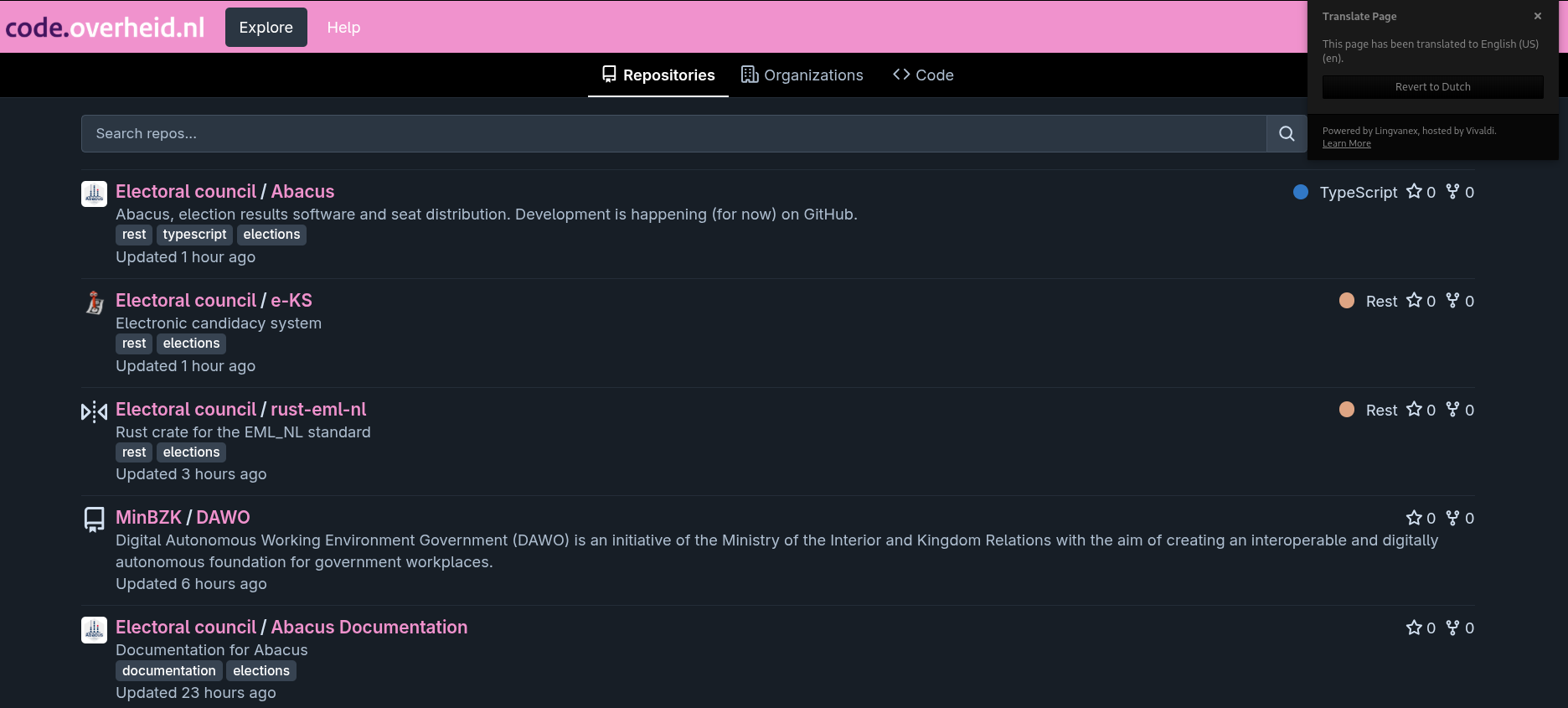
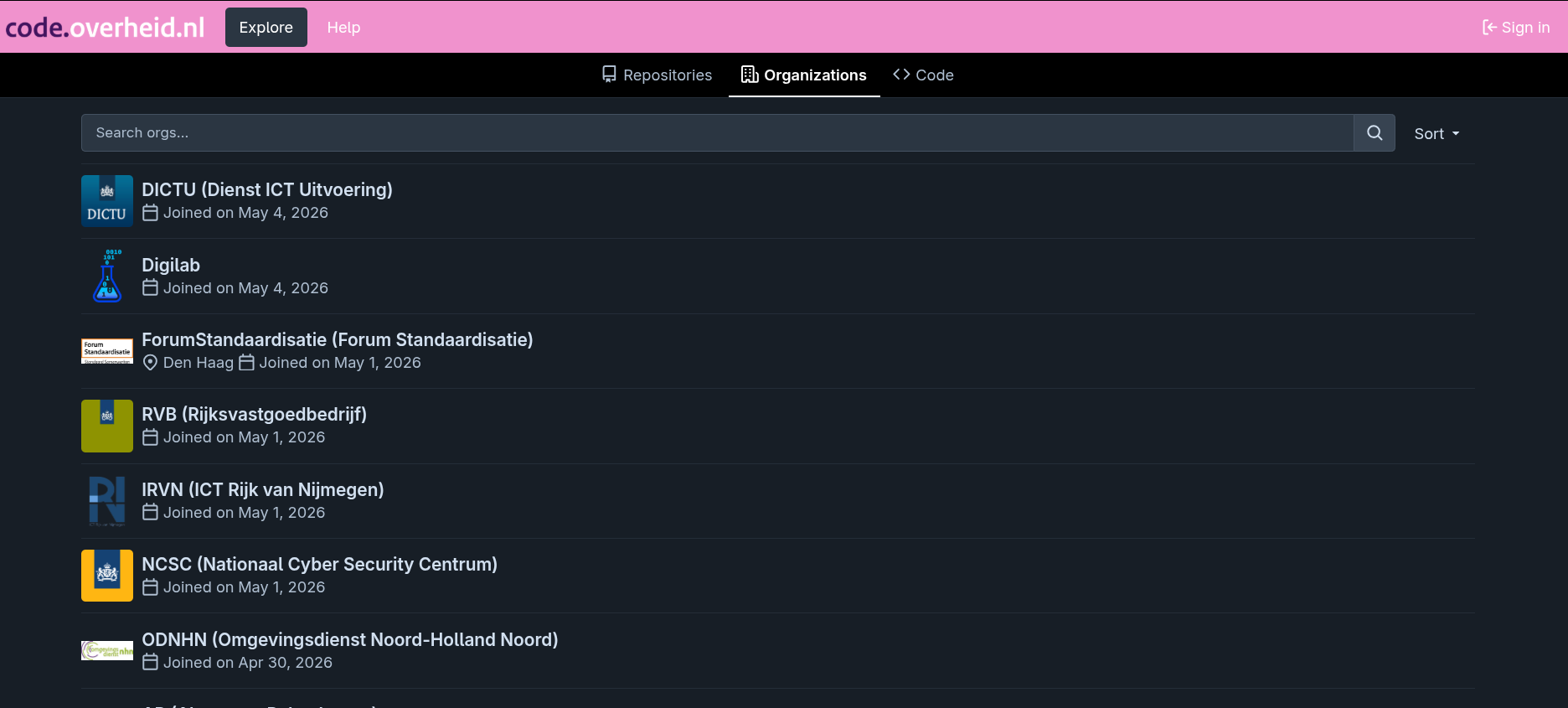
I had to translate the repos page to see what was in there.
The platform is live and already hosts some content. The most notable presence is Kiesraad, the Dutch Electoral Council, which has pushed several election-related repositories including Abacus, the software used for vote counting and seat distribution, and e-KS, an electronic candidate nomination system.
The Ministry of the Interior (BZK) has the DAWO project (their digital autonomous workplace initiative) on there, along with a DigiD source code release published under a freedom of information ruling.
On the organization side, the list of who has joined since the April 24 soft launch is telling. Multiple national ministries are already on the platform: Finance, Foreign Affairs, Agriculture, and Interior.
Several major municipalities have also signed up, including The Hague, Utrecht, Leiden, and Arnhem. For a platform still in pilot with no formal launch announcement, that’s a fairly significant roster.
Suggested Read 📖: A Mobile Dev Hackathon is Coming to the Netherlands
