
Linus Torvalds is Angry Again, This Time With ext4 Dev
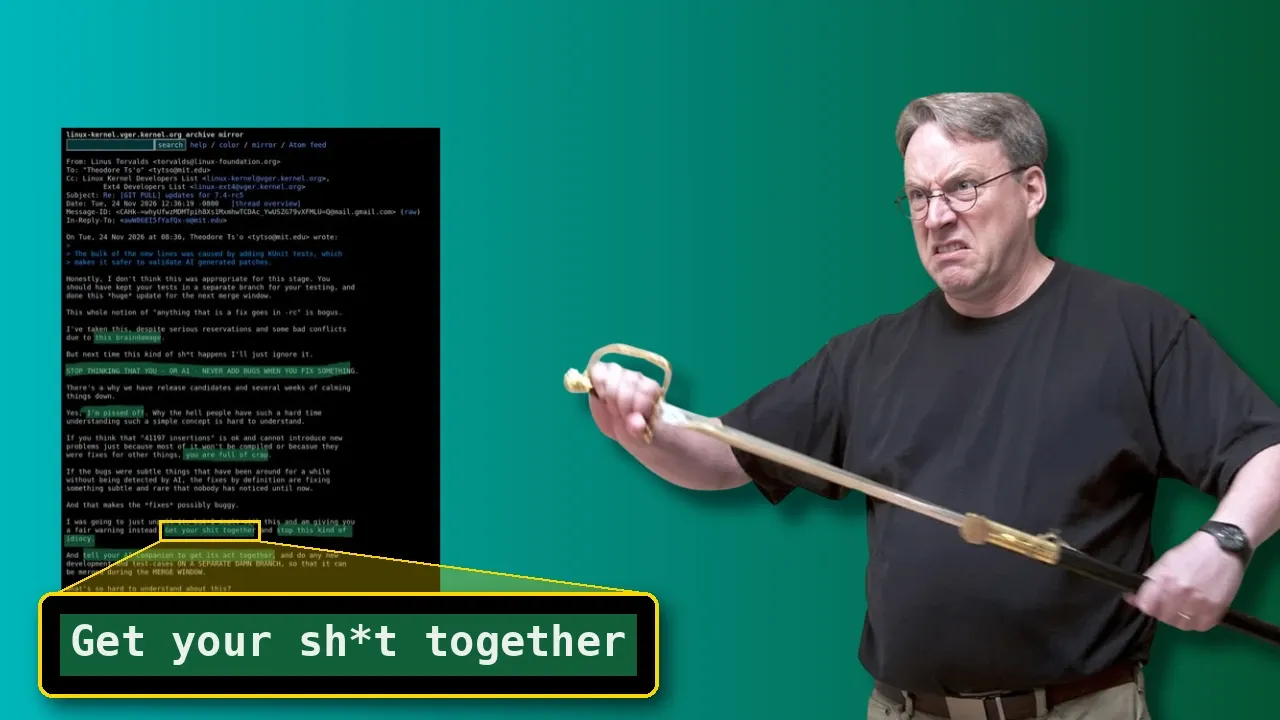
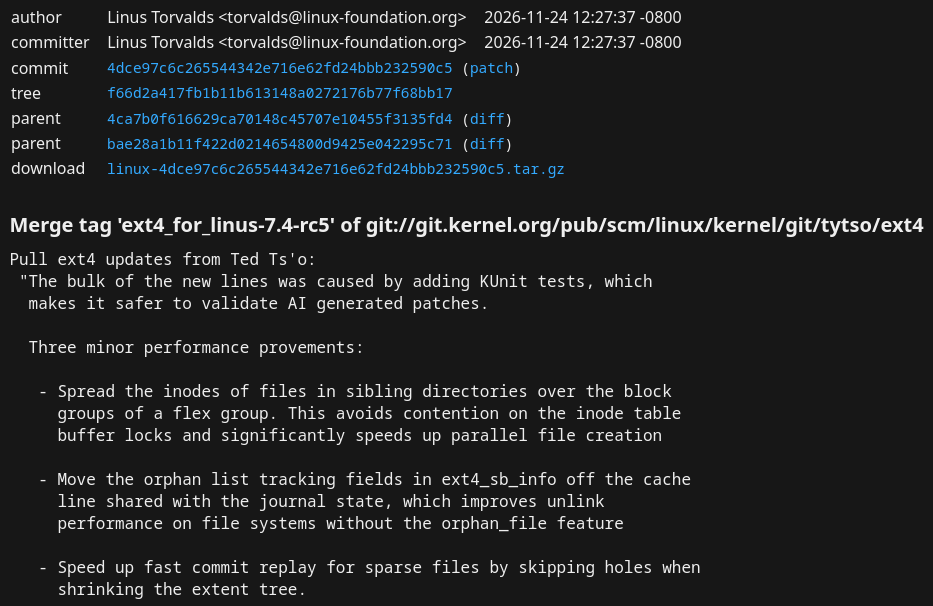
Theodore Ts’o, who maintains ext4, sent Linus Torvalds a pull request of 94 commits for Linux 7.4-rc5, and the merge commit that followed adds 41,204 lines across 68 files.
Ts’o said KUnit tests make up most of the added code and exist to help validate patches that AI generates, and that most of the bug fixes in the pull were AI generated as well.
What was in the pull that got Torvalds all worked up?
Before we dive into that, know that the ext4 filesystem grew out of ext3 and was built to be reliable and to scale to large storage, including filesystems larger than 16TB.
Whereas KUnit is the kernel’s unit testing framework, where tests are written in C and run against kernel code at boot or as a module.
The tests in Ts’o’s pull account for 22 of the 68 changed files in the merge commit. The rest is bug fixes and three minor performance changes.
One performance change spreads the inodes of files in sibling directories over a flex group’s block groups and speeds up parallel file creation. Another moves the orphan list fields off a shared cache line, and a third skips holes when replaying fast commits for sparse files.
The bug fixes include data loss cases, such as fsync’ed data lost after a journal flush and data lost during ext3 inode migration.
Others cover stale data after a failed zeroout, use-after-free bugs, out-of-bounds accesses on corrupted filesystems and a readdir problem with large directories on 32-bit kernels.
Torvalds objected to 41,197 lines of code being added so late in release cycle
Kernel development works in cycles, with new code going in during a merge window of about two weeks. The weekly release candidates that follow, called “rc” builds, are meant for fixes, and a cycle usually reaches somewhere between rc6 and rc9.
Torvalds objected that a pull of this size belongs in the merge window and that calling something a fix does not make it fit for an rc.
He said more than 41,000 added lines can cause new problems even when most of them are tests or fixes for other bugs. Fixes for old, subtle bugs can bring bugs of their own too, whether a person or an AI wrote them.
He took the pull after thinking about dropping it, and he closed his reply with a warning to Ts’o:
Get your shit together and stop this kind of
idiocy.And tell your AI companion to get its act together, and do any new development and test-cases ON A SEPARATE DAMN BRANCH, so that it can be merged during the MERGE WINDOW.
What’s so hard to understand about this?
How it ended
Ts’o replied that the tests were already on their own branch and had been placed at the end of the pull so they could be dropped easily. He offered to send a new pull request without them and hold the tests back until the next merge window opened.
Torvalds answered that he still partly objected, but he kept the merge. The conflicts from the test changes were not enough to make him undo it.
What Linus has said before
Torvalds complained in May about a bloated rc with pointless pull requests, much of it AI assisted, and promised to be tougher. But he has also said Linux is not one of those anti-AI projects.
By his count, the 7.4 merge window brought almost 20,000 commits against the roughly 15,000 that is typical. He would rather get AI fixes there than late in an rc, and he hopes they become mundane.
