
Linux May Get a New Home for AI Agent Skills

A Fixes tag in a kernel patch points to the commit that introduced the bug, but the last commit to touch a buggy line may only have moved the code to a new file.
Sasha Levin, who co-maintains the stable and long-term support kernel trees, wants AI coding assistants to verify which commit introduced a bug before assigning it a Fixes: tag.
His two-patch series went to the workflows and ksummit mailing lists last week, where he has proposed a new agents directory in the kernel tree to hold the skill that does it.
The new directory
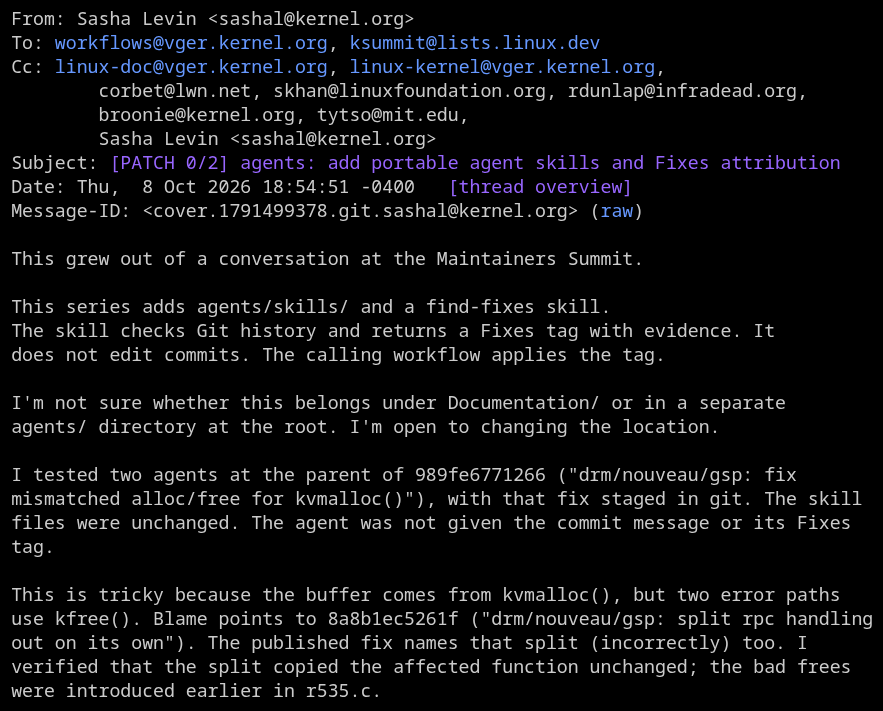
The first patch adds an agents/ directory at the top of the kernel source tree for skills, prompts, and other resources meant for coding assistants. It also adds a MAINTAINERS entry covering the directory.
Each skill gets its own folder under agents/skills/, with a SKILL.md file as its entry point, written in the Agent Skills format.
Assistants are told to read a resource directly from its path in the repository, and links inside a skill are relative to that skill’s folder. A new section in the kernel’s coding assistants document is meant to describe this layout.
The find-fixes skill, which arrives with the second patch, would be the first one in the directory.
Why do Fixes tags go wrong?
Levin says the series traces back to a question from Ted Ts’o about incorrect tags in stable tree work. He pointed to LLM workflows that help find the right commit.
Ted later explained that the request came from a talk with Hannes Reinecke, who estimated that 15 to 20 percent of Fixes tags are wrong.
That matters beyond bookkeeping, since the tag is how stable maintainers and distributions work out which kernels need a given fix. A wrong one can send a fix to the wrong branches or leave a bug unpatched.
The new find-fixes skill reads Git history and returns a proposed tag with its evidence, while leaving the commit itself untouched.
The skill’s guide.rst file says no single clue settles which commit a Fixes tag should name, not even an existing tag. The agent explains how the bug fails, traces candidate commits, and compares each against its parent.
It separates the commit that added the code, the one that made it defective, and any later change that only exposed the flaw.
For backported fixes, it checks whether the bug came from the original change or from how that change was adapted for an older kernel. Merges, reverts, and incomplete histories get their own handling.
When it cannot establish the origin, it returns no tag, lists the candidates and what is missing, and the fix stays a draft until someone resolves it.
Still a work in progress
The second patch would add a section to the kernel’s coding assistants document saying an assistant must follow the guide before finalizing a bug fix or its commit message and when reviewing an existing tag.
The document’s step for committing a fix would ask for a verified tag, where it now asks only for a Fixes tag. Keep in mind that the skill would not write commit messages, apply the tag, or decide whether a fix belongs in stable.
The series follows Levin’s earlier push for the kernel’s AI coding assistants policy, which we covered in April, and his proposal for a kernel killswitch.
Where the files should live is still open. The introductory patch message says he is unsure whether they belong under Documentation or in a separate agents directory at the root.
Greg Kroah-Hartman asked whether the series would fix tools skipping the kernel’s guidance because an AGENTS.md file is missing. Sasha replied that this is a separate issue for the symlink patch.
