
Will You Pay $119 For This Open Source KVM Built on Rust and Buildroot?
KVM devices let you remotely control a computer by capturing its display output and emulating a keyboard and mouse without having a hypervisor in the mix. They are an important tool in a sysadmin’s inventory.
Take a KVM-over-IP device, for instance; it operates independently of the target machine’s OS and network stack, letting you reach a system that is stuck in BIOS, frozen mid-boot, or completely offline.
That kind of access is crucial, and an open source device that delivers it without breaking the bank is rarer still. The LeafKVM is trying to be just that.
📝 LeafKVM: Key Specifications
Packed inside a CNC-milled aluminum enclosure, which also doubles as a passive cooling heatsink, the LeafKVM is powered by a Rockchip RV1126B SoC with a quad-core Cortex-A53 CPU and 512 MB of DDR3 RAM. Video capture is handled by a Lontium LT6911C CSI video bridge, and storage comes via a microSD slot.
There’s also a 2.4-inch IPS capacitive touchscreen, which lets you configure networking, preview the HDMI input, manage USB emulation, and check device status without needing a separate computer.
For the software, it runs a clean Buildroot 2026.02 LTS-based Linux system, with a Rust backend handling everything from the video pipeline to networking and USB emulation.
The touchscreen UI is built on Slint, and the web frontend is a GPL-2.0 fork of the JetKVM project. OTA firmware updates are a few clicks away from the web dashboard and Tailscale VPN integration is also on board.
Since the LeafKVM presents itself as a standard USB keyboard, mouse, and mass storage device to the target machine, it works with pretty much anything that supports those, including Linux, Windows, macOS, BSD, and BIOS/UEFI screens.
You don’t need to bother with drivers, as it is all plug-and-play! 🚀
The obvious audience for this device are IT engineers and server operators who want hands-off management after a one-time physical setup.
Robotics and embedded developers working with headless hardware can get a lot out of it too, since it removes the need to haul a monitor and keyboard to wherever the hardware lives.
And since the LeafKVM captures and streams HDMI video with under 100 ms latency at up to 4K/30fps or 1080p/90fps, it also works as a wireless video relay for camera setups where you want to preview a feed remotely on a tablet or laptop.
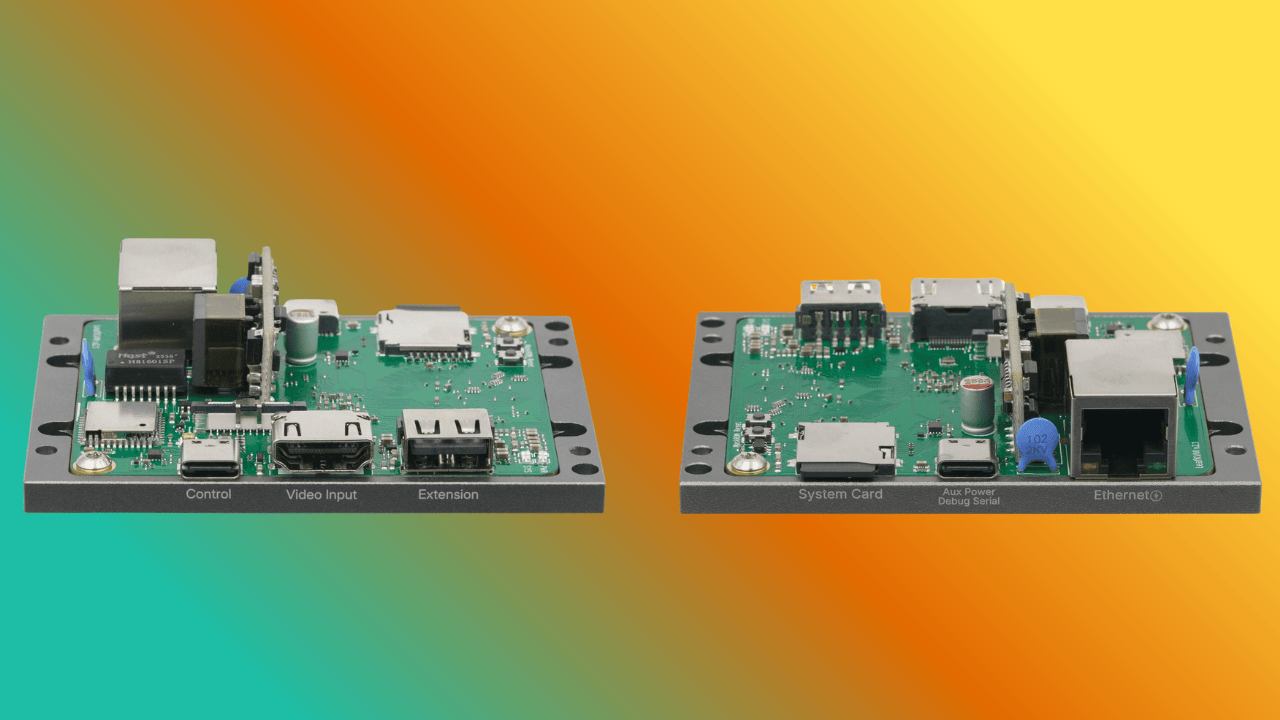
As for the ports and other doodads, they include:
- Ports: 1× HDMI (up to 4K@30fps), 2× USB Type-C, and 1× USB Type-A.
- Networking: Bluetooth, Wi-Fi 5 dual-band (433 Mbps), and 100 Mbps RJ45 Ethernet (with IEEE 802.3af PoE support).
- Weight: 195 g (6.9 Oz)
- Size: 90 × 65 × 25 mm (3.54 × 2.56 × 0.98 in)
- Power: USB Type‑C: 5 V / 1 A (both ports) and PoE (IEEE 802.3af 37-57 V)
Get Yours
At a price tag of $119, the LeafKVM is available on Crowd Supply, with units shipping mid-January 2027 if the funding goal is reached. Keep in mind that while shipping is free for buyers in the U.S., the rest of us will have to fork over an additional $12.
As of writing, 82%, that is, $8,222 of the $10,000 goal, had been reached thanks to 36 backers. With 40+ days remaining, I am sure that they will reach the funding goal sooner than later.
If you are looking for the schematics or the source code for the software, you can keep an eye out on the project’s GitHub. It is set to host the full firmware source, build recipes, and hardware schematics before units ship.
Suggested Read 📖: A Linux Gaming Console Appears
